


Page 4 - Lab Notebook
P. 4
Using Chemicals

          Do:             • Use only designated chemicals.
                          • Use as little reagent as needed to perform the experiment.
                          • Read labels and follow directions carefully.
                          • Use clean test tubes or beakers for carrying liquids.
                          • Use beakers, watch glasses, or small squares of paper for carrying solids.
                          •   Pour the reagent solutions into your own containers, in order to avoid contamination of
                           the stock solutions.
                          •   Hold bottle stoppers in your hand instead of setting them down to avoid picking up any
                           impurities from the bench and thus contaminating the solution when the stopper is put
                           back on the bottle.
                          • Replace stopper or cap tightly to avoid evaporation or spillage.
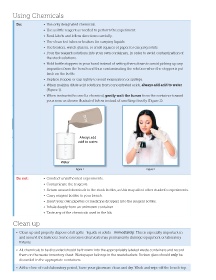
                          •  When making dilute acid solutions from concentrated acids, always add acid to water
                           (Figure 1).
                          •  When instructed to smell a chemical, gently waft the fumes from the container toward
                           your nose as shown illustrated below instead of smelling directly (Figure 2).


                                                   ACID


                                              Always add
                                             acid to water.


                                    Water
                                            Figure 1                                Figure 2


          Do not:         • Conduct unauthorized experiments.
                          • Contaminate the reagents.
                          • Return unused chemicals to the stock bottles, as this may affect other student’s experiments.
                          • Carry reagent bottles to your bench.
                          • Insert your own pipettes or medicine droppers into the reagent bottles.
                          • Inhale deeply from an unknown container.
                          • Taste any of the chemicals used in the lab.

        Clean up


          •  Clean up and properly dispose of all spills—liquids or solids—immediately. This is especially important in
            and around the balances. Some corrosive chemicals may permanently damage equipment or laboratory
            fixtures.

          •   All chemicals to be discarded should be thrown into the appropriately labeled waste containers and record
            them on the waste inventory sheet. Wastepaper belongs in the wastebaskets. Broken glass should only be
            discarded in the appropriate containers.

          •   At the close of each laboratory period, leave your glassware clean and dry. Wash and wipe off the bench top.

